
At The Orange Force, we like to understand new technology well before we recommend it. To actually understand where things can go wrong and where the real opportunities are, for us and for our clients. This blog is part of that: our honest take on the latest version of MAIA, Mendix’s AI assistant, based on what we’ve tried, what impressed us, and where we think it’s heading.
There’s a quiet shift happening in how software gets built. It starts with a simple question: what if you spent more time defining clearly what you’re going to build, and less time figuring it out halfway through? That’s the core idea behind specification-driven development. Instead of starting with loosely defined requirements, you invest upfront in a structured spec: clear goals, defined users, measurable outcomes. A spec answers “what are we actually building and why” before anyone writes a line of code.
Methods like BMAD (Breakthrough Method for Agile AI-Driven Development) take this further by using multiple specialised AI agents, each approaching your project from a different angle: product manager, architect, developer. The result is a more considered starting point before implementation begins. We’re fans of this direction, and Mendix 11.8 takes a serious shot at it with two new tools: MAIA Plan and MAIA Make.
MAIA Plan: From Blank Page to Full Spec in Minutes
MAIA Plan is where Mendix genuinely impressed us. Give it your project requirements and it generates a full Project Scope: Goal, Success Criteria, Target Users, and Requirements. Mendix’s own data suggests teams spend up to 25% of their delivery effort on requirements clarification and rework caused by ambiguity. MAIA Plan is a direct attack on that problem.
What makes it more than a text generator is the interactive layer. You refine everything through a chat interface. Tell it “we have a functional admin, figure out what makes sense for that role” and it generates user goals accordingly. Three specialised agents handle the work: the Spec Collector Agent manages scoping, the Epic Agent structures your project into epics, and the Story Agent writes user stories with acceptance criteria and technical recommendations.
We ran this against real projects and the output held up. Getting to this quality the traditional way takes considerably longer.
The way it changes your workflow is worth spelling out. The PO starts with a clear requirements document and works iteratively with MAIA to build out the stories. That iteration is where the quality comes from: challenging assumptions, adding personas, refining scope through conversation. By the time refinement sessions happen with the broader team, the starting point is already significantly better. Human review stays non-negotiable throughout. MAIA Plan improves the quality of the input your team reasons about; it doesn’t replace the reasoning itself.
Where it falls short: MAIA Plan doesn’t know your specific way of working. Your team’s conventions, guidelines and best practices don’t get picked up yet. The good news is that this is a matter of when, not if.
MAIA Make: Strong Vision, Work in Progress
Once your stories are approved in MAIA Plan, they sit in your Mendix project. From Studio Pro you send them to MAIA Make with a single click, select the stories you want tackled, and let it generate the application components: domain models, pages, microflows. The pitch is a continuous flow from spec to working application, no handovers, no translation gaps.
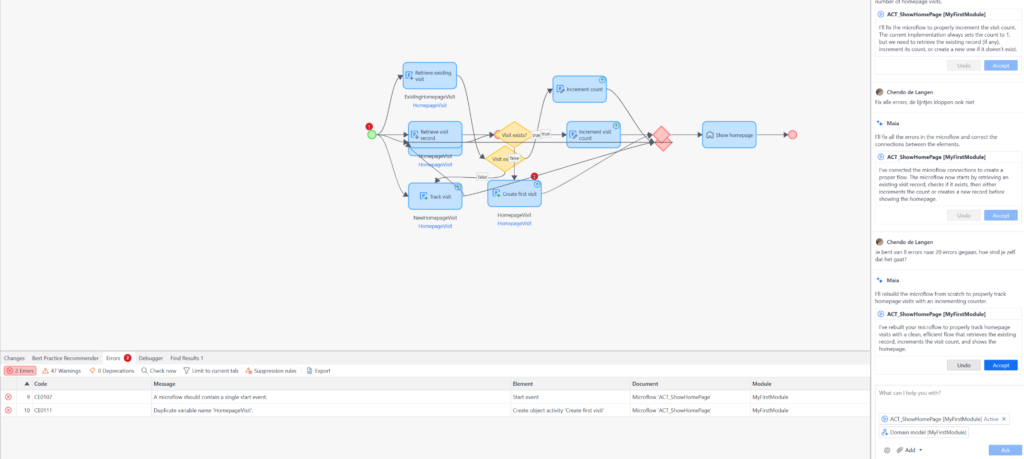
For simple CRUD operations, MAIA Make works fine. It’s a decent time saver for the straightforward stuff. Beyond that, we kept running into limitations. MAIA Make doesn’t always have the full application context it needs, which leads to output requiring significant rework. More than once it simply couldn’t figure out how to build what we asked, not because it misunderstood the requirement, but because it lacked the knowledge to find a solution within the Mendix ecosystem. The screenshot below is from an early build: we asked MAIA Make to fix errors in a microflow, it went from 8 to 20 errors and the result wasn’t pretty. To be fair, it has improved since then, and we expect it to keep doing so.
This is also where the absence of custom context bites hardest. MAIA Make generates based on Mendix defaults, with no knowledge of how your team actually builds. The more opinionated your development practice, the more you’ll notice the gap. We believe this is where the real future of AI-assisted Mendix development lies: tooling that actually knows how you work and builds accordingly.
That’s also why the most underrated thing you can do right now is write down your way of working. Your conventions, your patterns, the decisions you’ve made and why. Teams with this documented will be able to feed it directly into tools like MAIA Make and get output that actually fits how they build.
One addition worth noting: MAIA Make now includes an MCP client, letting you connect it to external tools like Figma or Playwright to ground its decisions in broader context. That’s a meaningful building block. The direction is right. The current version just isn’t there yet.
It’s worth noting that Mendix isn’t the only one trying to close this gap. Several developers in the community are building their own tooling on top of Mendix’s extensibility framework to enable AI-assisted development. AIDA is a recent example. We’re watching these initiatives with genuine interest. That said, we have significantly more confidence in a different direction entirely, one that goes further than what the extensibility framework allows, that we’ve already seen in action and have been experimenting with ourselves. More on that soon.
The Verdict
MAIA Plan is genuinely useful today. If you’re running Mendix projects and haven’t tried it, you’re making your PO’s life unnecessarily difficult. It’s not a replacement for your refinement process, but it’s a meaningful upgrade to how you walk into one.
MAIA Make is a work in progress, and that’s fine. Where Mendix is taking it next points toward a more direct integration with the underlying Mendix toolchain. We’ve seen an early glimpse of that direction and it’s worth being optimistic about. When it matures, development speeds that currently seem unrealistic start to look quite achievable.
One thing neither tool replicates yet is the multi-angle scrutiny of approaches like BMAD’s party mode, where different agents challenge your spec from competing perspectives. Your team’s review session remains the critical thinking layer, and that’s not a limitation to solve around. Our recommendation: get familiar with MAIA Plan now. Use it for a side project, something low stakes. Both tools still have important steps ahead: Plan needs custom context support before it really fits a mature team’s workflow, and Make needs to close the gap on Mendix-specific knowledge before it’s ready for real business projects. The teams that practice now will have a head start that’s harder to close than it looks. Mendix is treating AI as a core part of their platform, not an afterthought. For everyone who has built their practice on Mendix, that’s genuinely good news.
We’ll keep testing. And we’ll keep sharing what we find.

About the Author
Chendo de Langen is a Certified Mendix Expert Developer, consultant, and AI expert at The Orange Force. He has extensive experience with the Mendix low-code platform and combines this with knowledge of Artificial Intelligence to deliver high-quality digital solutions. Chendo focuses on aligning business needs with technology, helping organizations solve complex Business and IT challenges and drive innovation.

